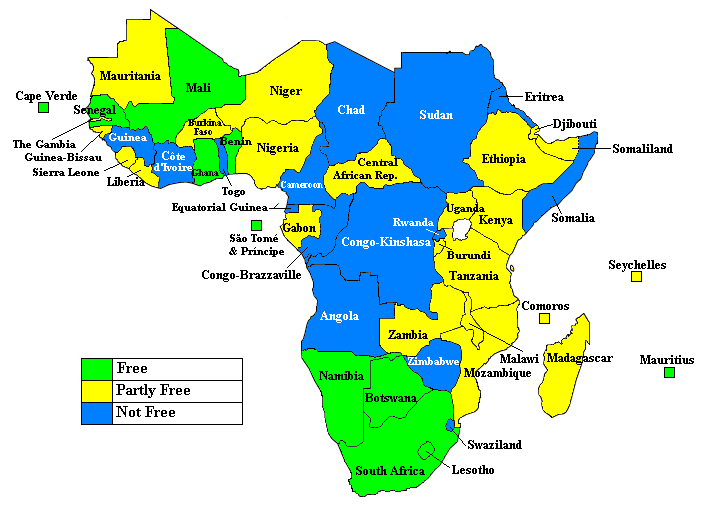
Table of African Countries*
Comparative Measures of Freedom
  up or down indicates a change in Political Rights, Civil Liberties, or Status since the last survey. In the Table, click
on the number preceding the arrow for an explanation of the rating and/or status change in the selected country. A rating
of 1 represents the most free and 7 the least free rating. up or down indicates a change in Political Rights, Civil Liberties, or Status since the last survey. In the Table, click
on the number preceding the arrow for an explanation of the rating and/or status change in the selected country. A rating
of 1 represents the most free and 7 the least free rating.
  Trend Arrows indicate general positive or negative trends since the previous survey that are not
necessarily reflected in the raw points and do not warrant a ratings change. Trend Arrows indicate general positive or negative trends since the previous survey that are not
necessarily reflected in the raw points and do not warrant a ratings change.
|
Trend |
Country |
Political Rights |
Civil Liberties |
Status |
|
_ |
Angola |
6 |
5 |
Not Free |
|
Ý |
Benin |
2 |
2 |
Free |
|
_ |
Botswana |
2 |
2 |
Free |
|
_ |
Burkina Faso |
5 |
3 |
Partly Free |
|
_ |
Burundi |
46 |
5 |
Partly Free |
|
_ |
Cameroon |
6 |
6 |
Not Free |
|
_ |
Cape Verde |
1 |
1 |
Free |
|
_ |
Central African Rep. |
5 |
4 |
Partly Free |
|
_ |
Chad |
6 |
66 |
Not Free |
|
_ |
Comoros |
35 |
4 |
Partly Free |
|
_ |
Congo-Brazzaville |
66 |
5 |
Not Free6 |
|
_ |
Congo-Kinshasa |
55 |
6 |
Not Free |
|
_ |
Côte d'Ivoire |
76 |
6 |
Not Free |
|
_ |
Djibouti |
5 |
5 |
Partly Free |
|
_ |
Equatorial Guinea |
7 |
6 |
Not Free |
|
ß |
Eritrea |
7 |
6 |
Not Free |
|
ß |
Ethiopia |
5 |
5 |
Partly Free |
|
_ |
Gabon |
6 |
4 |
Partly Free |
|
ß |
The Gambia |
5 |
4 |
Partly Free |
|
_ |
Ghana |
1 |
2 |
Free |
|
_ |
Guinea |
6 |
5 |
Not Free |
|
_ |
Guinea-Bissau |
46 |
4 |
Partly Free |
|
ß |
Kenya |
3 |
3 |
Partly Free |
|
_ |
Lesotho |
2 |
3 |
Free |
|
_ |
Liberia |
35 |
4 |
Partly Free |
|
_ |
Madagascar |
46 |
3 |
Partly Free |
|
_ |
Malawi |
4 |
35 |
Partly Free |
|
_ |
Mali |
2 |
2 |
Free |
|
_ |
Mauritania |
55 |
4 |
Partly Free |
|
_ |
Mauritius |
1 |
26 |
Free |
|
_ |
Mozambique |
3 |
4 |
Partly Free |
|
_ |
Namibia |
2 |
2 |
Free |
|
_ |
Niger |
3 |
3 |
Partly Free |
|
_ |
Nigeria |
4 |
4 |
Partly Free |
|
_ |
Rwanda |
6 |
5 |
Not Free |
|
_ |
São Tomé & Príncipe |
2 |
2 |
Free |
|
_ |
Senegal |
2 |
3 |
Free |
|
ß |
Seychelles |
3 |
3 |
Partly Free |
|
_ |
Sierra Leone |
4 |
3 |
Partly Free |
|
_ |
Somalia |
76 |
7 |
Not Free |
|
_ |
Somaliland |
4 |
4 |
Partly Free |
|
_ |
South Africa |
26 |
2 |
Free |
|
_ |
Sudan |
7 |
7 |
Not Free |
|
_ |
Swaziland |
7 |
5 |
Not Free |
|
_ |
Tanzania |
4 |
3 |
Partly Free |
|
_ |
Togo |
6 |
5 |
Not Free |
|
_ |
Uganda |
5 |
4 |
Partly Free |
|
_ |
Zambia |
35 |
4 |
Partly Free |
|
ß |
Zimbabwe |
7 |
6 |
Not Free |
*The ratings in this table reflect global events
from 1 December 2005 through 31 December 2006.
Criteria for designation as an Electoral Democracy
1. A competitive, multiparty
political system.
2. Universal adult suffrage
for all citizens (with exceptions for restrictions that states may legitimately place on citizens as sanctions for criminal
offenses).
3. Regularly contested
elections conducted in conditions of ballot secrecy, reasonable ballot security, and the absence of massive voter fraud that
yields results that are unrepresentative of the public will.
4. Significant public
access of major political parties to the electorate through the media and through generally open political campaigning.
Status and Ratings Changes, Trend Arrow
Explanations
Benin received
an upward trend arrow due to free and fair March presidential elections, which allowed for the peaceful transfer of power
to an independent candidate.
Burundi's Political
Rights rating declined from 3 to 4 due to the government and ruling party’s increased repression of the opposition.
Chad’s Civil
Liberties rating declined from 5 to 6 due to increased insecurity in the eastern part of the country as a result of the crisis
in neighboring Sudan's Darfur region.
Comoros' Political
Rights rating improved from 4 to 3 due to the holding of legitimate presidential elections and a decline in military influence
over political choices.
Congo-Brazzaville's
Political rights rating declined from 5 to 6, and status from Partly Free to Not Free, due to decreased openness and transparency
in government.
Congo-Kinshasa's
Political Rights rating improved from 6 to 5 due to the holding of successful presidential and legislative elections in 2006,
the country’s first in more than 40 years.
Côte d'Ivoire's
Political Rights rating declined from 6 to 7 due to the legislature’s continuing to function without a mandate as a
result of President Gbagbo's further postponement of presidential elections.
Eritrea received
a downward trend arrow due to unequal treatment for religious minorities under the law.
Ethiopia received
a downward trend arrow due to the government's repression of opposition protests.
The Gambia received
a downward trend arrow because of political harassment by the National Intelligence Agency following a coup attempt in March.
Guinea-Bissau's
Political Rights rating declined from 3 to 4 due to President João Bernardo Vieira's dismissal of the opposition prime minister,
whose party held the legislative majority, in favor of a political ally.
Kenya received
a downward trend arrow because of a lack of transparency regarding governmental anti-corruption efforts.
Liberia's Political
Rights rating improved from 4 to 3 due to improvements in governmental efforts to combat corruption and to greater government
transparency.
Madagascar's Political
Rights rating declined from 3 to 4 due to serious irregularities during the presidential elections, including the disqualification
of an opposition candidate and the use of multiple ballots.
Malawi's Civil
Liberties rating improved from 4 to 3 due to a decline in police excess against the political opposition.
Mauritania's Political
Rights rating improved from 6 to 5 due to changes to the electoral framework to include the creation of an independent electoral
commission, as well as to greater political pluralism and government transparency.
Mauritius' Civil
Liberties rating declined from 1 to 2 because of an increase in crime and the government's failure to address it.
Seychelles received
a downward trend arrow because of a crackdown on the opposition, including the adoption of a bill widely perceived as designed
to forestall plans by an opposition party to establish its own radio station.
Somalia's Political
Rights rating declined from 6 to 7 due to the increased consolidation of power of the Islamic Court Union—especially
in Mogadishu—which is not a freely elected government accountable to the people and which has worked to limit political
participation.
The breakaway region of Somaliland was judged separately from
Somalia in this year's survey.
South Africa's
Political Rights rating declined from 1 to 2 due to the ruling ANC's increasing monopoly on policymaking and its increasingly
technocratic nature.
Zambia's Political
Rights rating improved from 4 to 3 because of the successful conduct of its presidential election, reportedly the best since
1991, and concurrent legislative elections. Zambia was also designated an electoral democracy in this survey.
Zimbabwe received
a downward trend arrow due to increasingly violent crackdowns on the opposition, growing militarization of state agencies
and functions, and a deterioration in conditions for thousands displaced by Operation Murambatsvina.
|
 |
|
|
|
|
|
|
|
|
|