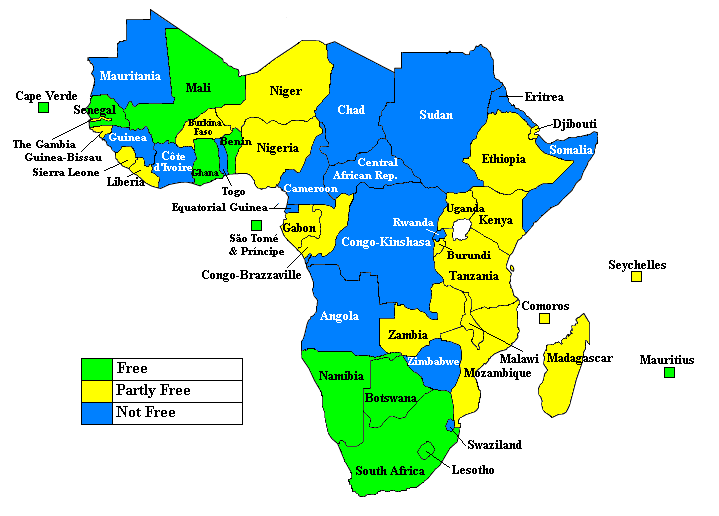
*The ratings in this table reflect global events from 1 December 2003
through 30 November 2004.
Criteria for designation as an Electoral Democracy
1. A competitive, multiparty political system.
2. Universal adult suffrage for all citizens
(with exceptions for restrictions that states may legitimately place on citizens as sanctions for criminal offenses).
3. Regularly contested elections conducted
in conditions of ballot secrecy, reasonable ballot security, and the absence of massive voter fraud that yields results that
are unrepresentative of the public will.
4. Significant public access of major political
parties to the electorate through the media and through generally open political campaigning.
Status and Ratings Changes, Trend Arrow
Explanations
Burkina Faso: Political Rights declined (from
4 to 5) due to an increase in corruption and reports of illegal arms trafficking.
Central African Republic:
Political Rights improved (from 7 to 6) as a result of increased political activism in preparation for democratic elections
in 2005.
Comoros: Political Rights improved (from 5 to
4) as a result of increased political contestation in its National Assembly. The nation was also designated as an electoral
democracy in this survey.
Côte d'Ivoire: Civil Liberties decreased (from
5 to 6) due to the deterioration in security and civil freedoms resulting from an upsurge in hostilities emulating from an
unresolved civil conflict.
Guinea-Bissau: Political Rights improved (from
6 to 4) as a result of legislative elections that international observers pronounced as largely free and fair.
Liberia: Both Political Rights and Civil Liberties
improved (Political Rights from 6 to 5; Civil Liberties from 6 to 4) as a result of greater political freedom that developed
through the establishment of a broad-based, transitional government. These improvements were significant enough to improve
the nation’s status from "Not Free" to "Partly Free".
Malawi: Political Rights declined (from 3 to 4)
due to flawed political elections.
Mauritius: The country further increased its Civil
Liberties score (from 2 to 1) through the consolidation of associational rights and social equalities.
Niger: Both Political Rights and Civil Liberties
improved (both from 4 to 3) due to increased representation of minorities in government and because of efforts to improve
the status of women.
Zimbabwe: Political Rights declined (from 6 to
7) due to increased government repression of the political opposition. 

 up or down indicates a change in Political Rights, Civil Liberties, or Status since the last survey. In the Table, click
on the number preceding the arrow for an explanation of the rating and/or status change in the selected country. A rating
of 1 represents the most free and 7 the least free rating.
up or down indicates a change in Political Rights, Civil Liberties, or Status since the last survey. In the Table, click
on the number preceding the arrow for an explanation of the rating and/or status change in the selected country. A rating
of 1 represents the most free and 7 the least free rating.
 Trend Arrows indicate general positive or negative trends since the previous survey that are not
necessarily reflected in the raw points and do not warrant a ratings change.
Trend Arrows indicate general positive or negative trends since the previous survey that are not
necessarily reflected in the raw points and do not warrant a ratings change.